Sunday, August 18, 2019

PYTHON COURSE IN VIJAYAWADA

PYTHON COURSE IN VIJAYAWADA

Python Language Introduction

Python is a widely used general-purpose, high level programming language. It was initially designed by Guido van Rossum in 1991 and developed by Python Software Foundation. It was mainly developed for emphasis on code readability, and its syntax allows programmers to express concepts in fewer lines of code.
Python is a programming language that lets you work quickly and integrate systems more efficiently.
There are two major Python versions- Python 2 and Python 3. Both are quite different.

SAP COURSE IN VIJAYAWADA

SAP COURSE IN VIJAYAWADA

SAP is a market leader in providing ERP (Enterprise Resource and Planning) solutions and services. In this chapter, we will try to understand more on ERP and where it should be used. In addition, we will learn the implementation techniques of ERP along with the ERP packages available in the market.

What is ERP?

Enterprise Resource Planning (ERP) is a software that is built to organizations belonging to different industrial sectors, regardless of their size and strength.
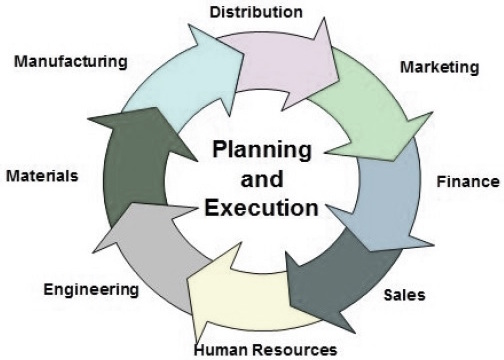
The ERP package is designed to support and integrate almost every functional area of a business process such as procurement of goods and services, sale and distribution, finance, accountings, human resource, manufacturing, production planning, logistics & warehouse management.
Planning and Executing

Business Process Integration

Every business, regardless of the industry they belong to, require connected systems with efficient information flow from one business process to another. Business Process Integration (BPI) plays an important role in overcoming integrating challenges that allows organizations to connect systems internally and externally.
Business Process Integration (BPI) allows −
  • automation of business processes,
  • integration of systems and services,
  • secure sharing of data across numerous applications, and
  • automation of management, operational, and supporting process.
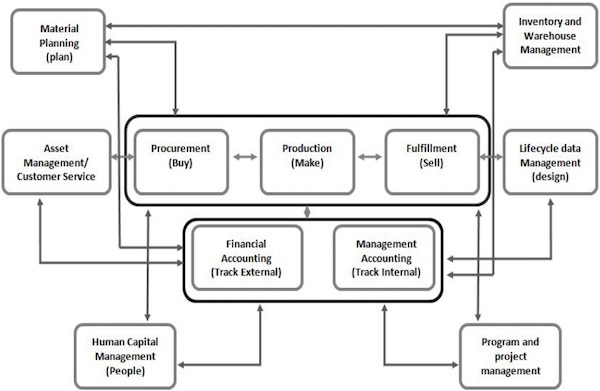
The following illustration shows an overview of various business processes running in an enterprise and how they are integrated.
Business Process Integration

Evolution of ERP

During early phases of development, integrated solutions were designed for particular process areas such as −
  • Material Management − the integrated system was known as Material Requirement Planning (MRP)
  • Manufacturing − the integrated system was known as Manufacturing Resource Planning
However none of the integrated systems came with a complete solution for an organization covering major business process areas. In early 1990’s, the Gartner Group first used the acronym ERP. By mid–1990’s, ERP systems addressed all the core enterprise functions.
In the early stages, most of the ERP solutions were focused on automating back office functions that were not directly affecting customers or general public. Later, front office functions such as customer relationship management and e–business systems were integrated.

Functions of ERP

An ERP system typically performs the following functions −
  • Supports the integrated business process inside the organization.
  • Improves capital planning and helps in executing organizational plans and strategies.
  • Helps speed up the decision-making process over the analysis of accurate data.
  • Helps extend the business network to wider domains, expanding the products and services to reach more customers, suppliers, and partners.
  • Identifies operational risks to improve governance.
  • Provides protection against organizational data breaches and security threats to leakage of information.
  • Makes the organization adaptable to the rapid changes in the business process according to the needs.
  • Gives long-term profit by providing means to increase the customer base.

Saturday, August 17, 2019

SAP FICO TRAINING INSTITUTES IN VIJAYAWADA

SAP FICO TRAINING INSTITUTES IN VIJAYAWADA

SAP FI is a module used for reporting both externally and internally. The objective is to record all financial transactions that are posted by an entity and produce financial statements which are accurate at the end of the trading period. This tutorial is going to explain the major functionalities with SAP FI module.
SAP FI is made up of sub modules. The sub-modules that are often used are accounts receivables, accounts payables, asset accounting, general ledgerAccounting and bank accounting.
All the sub modules are interlinked and integrate in real time. A trial balance can be extracted at an time and it will always balance because all the sub modules are connected. The diagram below shows the the integration between SAP FI modules.
SAP Controlling (CO) is another important SAP module offered to an organization. It supports coordination, monitoring, and optimization of all the processes in an organization. SAP CO includes managing and configuring master data that covers cost and profit centers, internal orders, and other cost elements and functional areas.
This is an introductory tutorial that covers the basics of SAP FICO and how to deal with its various modules and sub-modules.

Friday, August 16, 2019

TALLY WITH GST FULL COURSE WITH IN 30 DAYS LOWCOST

Tally Solutions, then known as Peutronics, was co-founded in 1986 by Shyam Sunder Goenka and his son Bharat Goenka. [Shyam Sundar Goenka was running a company that supplied raw materials and machine parts to plants and textile mills in southern and eastern India. Unable to find software that could manage his books of accounts, he asked his son, Bharat Goenka, 23, a Maths graduate to create a software application that would handle financial accounts for his business.[The first version of the accounting software was launched as an MS-DOS application. It had only basic accounting functions, and was named Peutronics Financial Accountant.

  • In 1999, the company formally changed its name to Tally Solutions.
  • In 2006, Tally launched Tally 8.1, a concurrent multi-lingual version, and also Tally 9.
  • In 2009, the company released Tally.ERP 9, a business management solution
  • In 2015, the company launched a program called Vriddhi to certify and classify its business partners.[9] Also in 2015, Tally Solutions announced the launch of Tally.ERP 9 Release 5.0 with taxation and compliance features.
  • As of 2016, the company had 1 million customers.
  • In 2016, Tally Solutions was shortlisted as a GST Suvidha Provider to provide interface between the new Goods and Services Tax (GST) server and taxpayers, and in 2017, the company launched its updated GST compliance software.

SAP FICO TRAINING INSTITUTES IN VIJAYAWADA

SAP FI stands for Financial Accounting and it is one of important modules of SAP ERP. It is used to store the financial data of an organization. SAP FI helps to analyze the financial conditions of a company in the market. It can integrate with other SAP modules like SAP SD, SAP PP, SAP MM, SAP SCM, etc.
SAP Controlling (CO) is another important SAP module offered to an organization. It supports coordination, monitoring, and optimization of all the processes in an organization. SAP CO includes managing and configuring master data that covers cost and profit centers, internal orders, and other cost elements and functional areas.
This is an introductory tutorial that covers the basics of SAP FICO and how to deal with its various modules and sub-modules.

JAVA TRAINING INSTITUTE IN VIJAYAWADA

WE ARE PROVIDING CORE AND ADVANCE JAVA WITH HIGH QUALITY.IF U WANT TO JOIN PLS COME FOR DEMO CLASSES THIS WEEK. https://psrtechnoskills....